

Lead (Pb)
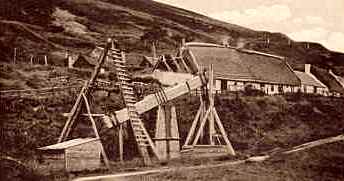
Lead mining in Southern Scotland. The beam engine at the former lead mine in Wanlockhead, c. 1900. This now forms part of the Lead Mining Museum. Photograph courtesy of the Wanlockhead Museum Trust.
For details on blood lead occupational monitoring, see this page.
For details on interpretation of raised blood lead results in non-occupationally exposed individuals, see below.
Inorganic lead compounds have been known to be a toxic hazard for many hundreds of years. Environmental exposure to lead has reduced considerably with the introduction of lead-free petrol, removal of lead from paint, reduction of lead in potable water supplies, removal of lead plumbing, and treatment of water to reduce plumbo-solvency. Nevertheless, lead poisoning can still occur, usually as a result of occupational exposure, in plumbers, stain glass window workers, paint strippers etc. Blood lead measurement provides a reliable guide to lead exposure. Control of lead exposure at work is covered by regulations (Control of Lead at Work, or CLAW)38 which stipulate regular blood lead monitoring. The industrial action limit, above which workers are legally required to be suspended from work, is currently 2.90 µmol/L (60 µg/100 mL).39 See this page for further details.
Lead inhibits several enzymes in the haem synthesis pathway and so concentrations of several porphyrins increase especially when blood lead exceeds 2.0 µmol/L. At about this concentration other effects may result such as fatigue, depression, irritability, cognitive impairment, headaches, weakness and constipation. More severe poisoning may cause anaemia, renal tubular dysfunction and peripheral neuropathy. Zinc protoporphyrin (ZPP) has historically been measured as an alternative marker although this analyte also increases in patients with iron deficiency anaemia. ZPP analysis is no longer available at STEMDRL.
In children, lead may have significant neurological effects. Children are more prone to exposure since intestinal absorption is more efficient than in adults. Pica, the repetitive ingestion of non-food substances by young children, may present a hazard in poorly maintained housing with lead-based paint. The traditional remedies of a number of non-Western areas of the world may contain substantial amounts of lead and several instances of clinical lead poisoning by ingestion of Asian traditional remedies have been reported in the UK. Middle Eastern and Asian eye cosmetics may also contain lead, and their use on infants or by their mothers is associated with increased blood lead levels in the infants concerned. Ingestion of traditional remedies or application of eye cosmetics is now the commonest form of lead poisoning in children.
Subtle toxic effects of lead on behaviour can be found even in children whose blood lead concentrations are ‘normal’.40 In 2012 the US Center for Disease Control (CDC) reduced the reference threshold concentration for lead in children under five years to ≤ 0.24 µmol/L.41 This followed results from a population survey of blood lead concentrations in the United States which showed that the 97.5th percentile at 5 µg/dL (0.24 µmol/L) and replaced the previous 10 µg/dL ‘level of concern’. In 2021 CDC further reduced the 'Blood Lead Reference Value' to 3.5 µg/dL (0.17 µmol/L).42
The measurement of urinary lead is only recommended for monitoring of chelation therapy or for assessment of exposure to alkyl-leads. Urine lead analysis is not available at STEMDRL.
Interpretation of raised blood lead results
We recommend following guidance developed with input from the SAS Trace Element group and the National Poisons Information Service (NPIS) when considering what action to take in response to a raised blood lead. The full guidance can be found here. The following link from the guidance contains suggested actions when a raised blood lead result is found in a non-occupationally exposed individual:

If it is necessary to contact Public Health, Health Protection Team (HPT) contacts can be found here.
If it is necessary to seek advice on clinical management of patients with raised blood lead, please contact the NPIS.
Further Information
This site
Units for blood lead measurement (including an on-line convertor}
External sites
Museum of Lead Mining, Wanlockhead, Scotland
GLASS (Global Lead Advice and Support Service)
Sample Requirements and Reference Ranges for Lead
| Sample Type | Blood, water* |
|---|---|
| Container |
Blood: EDTA or lithium heparin (non-gel). Water: Universal container |
| Precautions |
Blood: Send by first class post to arrive within 72 hours of collection. If delivery to Glasgow will be outwith 72 hours, store whole blood frozen until sending and then send by first class post. Blood samples for occupational exposure should be taken at the end of a working shift. Contamination is associated with paediatric containers with rubber inserts or O-rings in the cap. These samples and lithium heparin gel tubes are unsuitable. |
| Minimum volume* |
Blood: 350 µL** Water: 1 mL |
| Reference ranges |
Blood lead: < 0.10 µmol/L88 > 2.90 µmol/L (60 µg/100mL) (CLAW suspension limit)38
|
| Turnaround time |
See this page for STEMDRL TAT targets |
| Method | Inductively coupled plasma mass spectrometry |
| Traceability |
Blood: Traceable to reference material produced in accordance with EN ISO 17511:2003 “In vitro diagnostic medical devices. Measurement of quantities in biological samples. Metrological traceability of values assigned to calibrators and control materials” and reference materials with values determined by reference laboratories. Water: Traceable to certified reference material ERM CA022a |
| Intermediate Precision (CV) | See this page for latest data |
| Measurement Uncertainty, U | See this page for latest data |
| Analytical Goals (CV) |
See this page for latest data Blood lead goal is based on biological variation43 |
| EQA Scheme |
Blood: UK NEQAS, Guildford (once per month) |
| Included in UKAS scope? |
Blood: Yes Water: No |
* For assessment of lead in water, two samples are recommended; a first draw sample in the morning and a further sample taken after running the water for 5 - 10 mins.
** Absolute minimum volume; this volume is insufficient to carry out repeat analysis if analysis fails.